Use these learning tools alongside your lessons and the current ICBC guide. Class 2 study resources are included; contact the school about training availability.
Choose Class 1, Class 2, Class 3 or Air Brake to see the eligibility, training and testing requirements students should understand before getting started.
01Class 1
Class 1 student requirements
For semi-trailer trucks and most other vehicle combinations. New applicants move from commercial eligibility and a Class 1 learner’s licence through mandatory entry-level training and the Class 1 road test.
Minimum age: 19
Full-privilege Class 5 or 6 licence, or equivalent
Air-brake learning is included in Class 1 entry-level training
Student pathwayEligibility → Training → Testing
01
Before you apply
Be at least 19.
Hold or have held a full-privilege Class 5 or 6 licence, or an out-of-province equivalent.
Have fewer than four penalty-point incidents in the previous two years and no driving-related criminal convictions in the previous three years.
Clear outstanding ICBC fines and debts, and meet medical-fitness and vision standards.
02
Learner & training
Study the commercial guide and pass the Class 1 knowledge and road-sign tests.
Receive a Class 1 learner’s licence before starting mandatory entry-level training.
Complete the required theory, practical and on-highway training. Air-brake operation is included.
03
Full licence tests
Practise with an appropriately licensed supervisor or instructor.
Bring an acceptable Class 1 tractor-trailer and the required pre-trip tools.
Complete the pre-trip and written inspection report, pass the road test, and complete the driver medical process.
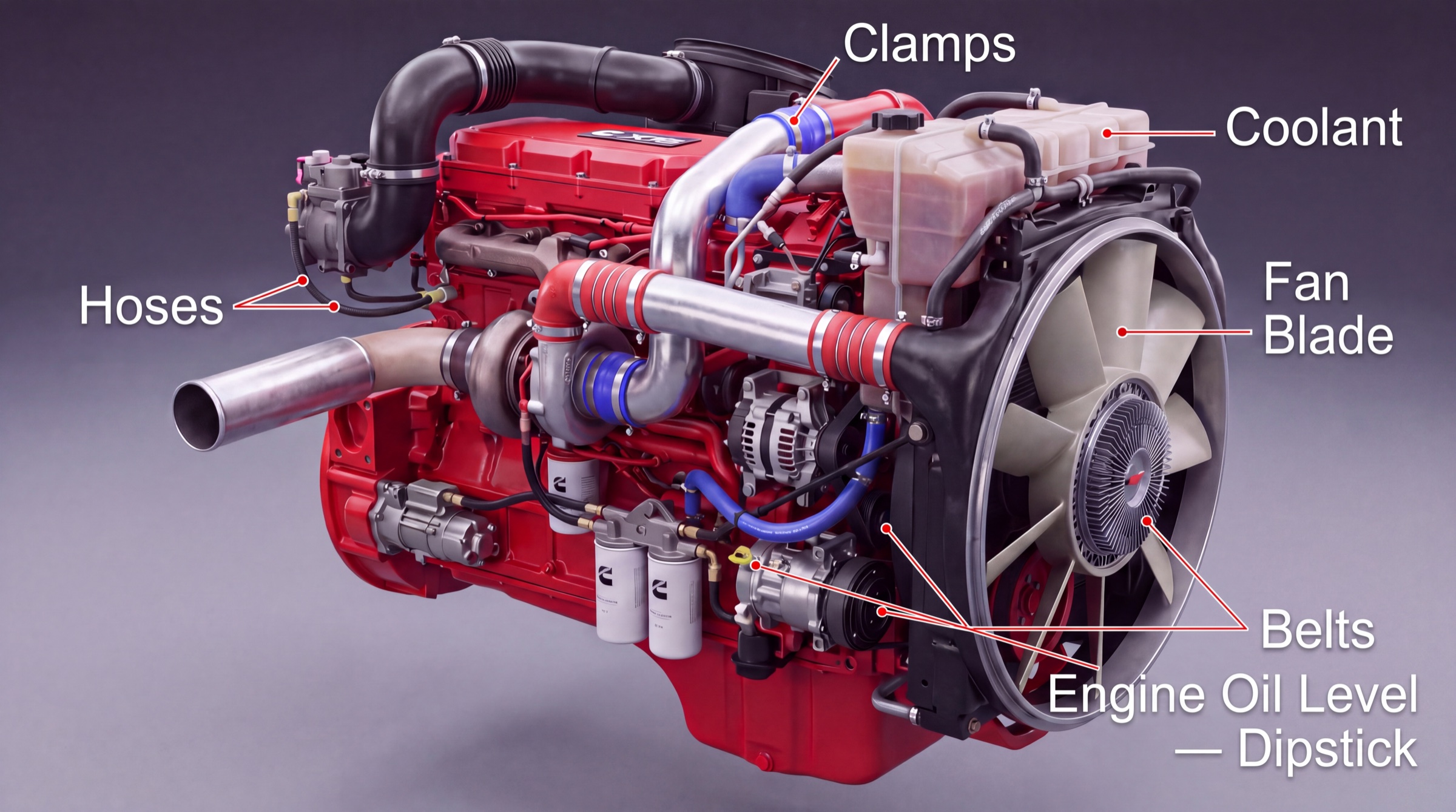
01 / Under hoodFan, belts, hoses, clamps, coolant & oil
01
Under hood
Fluid levels
Secure the combination first. As you approach, look underneath for leaks, drain the supply reservoir for the road test, then inspect the engine bay in a consistent order.
What to inspect
With the truck secured and engine off, check the engine-oil level on the dipstick using the manufacturer’s procedure; the oil should be within the marked operating range. Check coolant, power-steering fluid and windshield-washer fluid for level and condition.
Why it matters
A low dipstick reading or contaminated fluid can warn of a leak, lubrication problem, overheating or loss of steering assistance.
Say it during the check“I am checking the engine-oil level on the dipstick and each remaining fluid for the correct level, condition, secure cap and signs of leakage.”
Guide p. 205 · Study support—vehicle layouts and test procedures can vary.
Choose a component6 checkpoints
02 / Safety physics
Stopping power multiplier.
1×
Vehicle speedSame speed
Vehicle weightSame weight
Doubling weight needs 2× the stopping power. Doubling speed needs 4×. Doubling both needs 8×.
ICBC guide: p. 20
SeePerception
+
ThinkReaction
+
Air systemBrake lag
+
DoBraking
=
TotalStopping time
Student notice: These requirement summaries and learning tools paraphrase selected material from ICBC’s Driving Commercial Vehicles guide and were checked against ICBC’s online commercial-licence and air-brake information in August 2026. Requirements, exemptions, fees and accepted test vehicles can change. Confirm your individual path with ICBC before applying.